Why Founder-Led Companies Win

Hey investor 👋
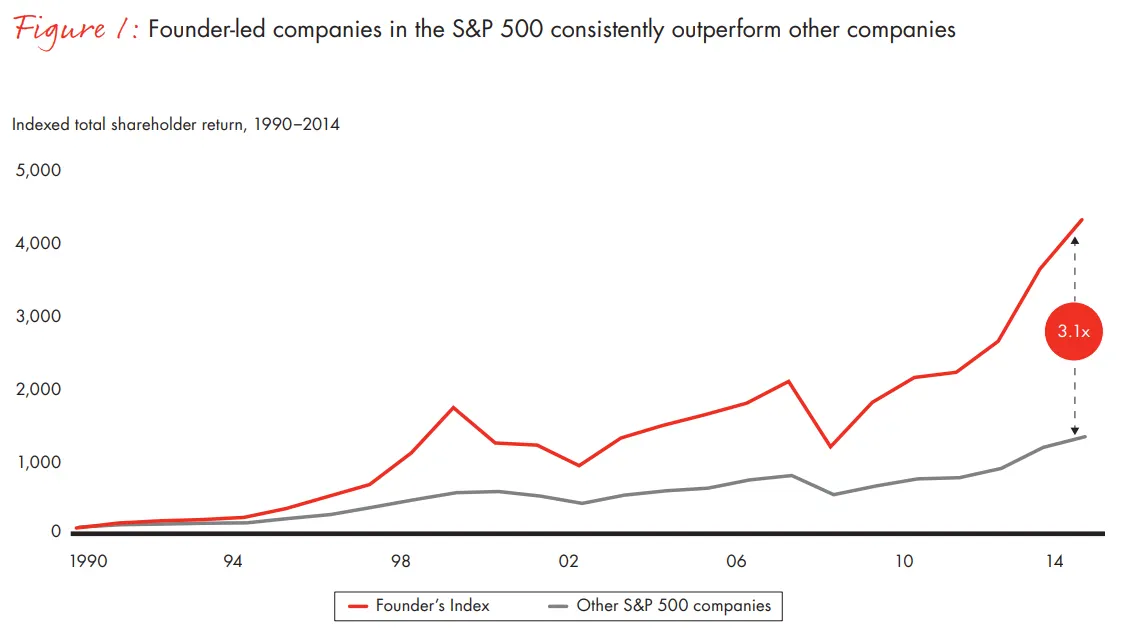
Here's the statistic we all know so well, yet that still gets us excited each time we read it: Founder-led companies outperform.
Source: Bain & Company
From 1990 to 2014, founder-led businesses outperformed "corporate" CEOs by 3.1x.
That's a pretty wild statistic.
Maybe you've theorized why, but never really dug into the weeds on the mechanism of this outperformance.
Let's break it down into three chapters.
Table of Contents
-
Psychological Tethering
-
Capital Allocation and Long-Term Orientation
-
Cultural Advantages
1. Psychological Tethering
Let's demonstrate this section with an analogy.
You've been hired at a restaurant as a head chef.
Chances are, as a part of this job, your main focus would be to execute the dishes ordered by customers to the best of your ability.
You care about your success as it relates to your role and wages, but generally speaking, you might not be in love with the business itself.
Now imagine you opened your own restaurant, with your name above the front door.
Your name is tied to this business.
People associate the business's success with your own.
And you certainly care about building a strong brand for yourself.
The result?
You going to execute every dish to perfection.

Not only this, but you also care more about the well-being of the business, whether it be margins, growth, long-term stability, or ratings from customers.
With this extra attention to detail comes a level of involvement not attainable by many other corporate CEOs.
You become engrossed in your business.
You think about the restaurant day-in and day-out.
A new dish idea pops into your head on a Saturday night at 8 PM while with friends, and you hurry to write your thoughts down on your notes app.
And the cycle never stops. You build and innovate until you can't anymore.
That extra level of care and effort is exactly what a founder possesses.
But more importantly, this effort is not short-term oriented.
Founders tend to have a longer-term view and tend to make business decisions to optimize for the long-term durability and stability of their business.
Take this excerpt from a 2009 paper:
“Founder-CEOs often consider their firm as their life's achievement. This intrinsic motivation and long-term approach encourages founder-CEOs to pursue the optimal shareholder-value maximizing strategy instead of concentrating on short-term actions or "enjoying the quiet life." (Fahlenbrach, 2009)
Said more plainly, a founder's motivation and business decision-making framework is different than that of a typical corporate CEO.
This manifests itself in a common concept from Warren Buffett I've adored for quite some time: The Institutional Imperative.
This describes the tendency for corporate CEOs and capital allocators to blindly copy what competitors and peers are doing around them.
The result?
-
Contrarian bets become less likely
-
CEOs optimize for short-term results rather than long-term success
-
Reinvestment rate is lower
-
Companies refuse to reinvent themselves and innovate
In other words, founder CEOs are more likely to resist the institutional imperative and focus on the long-term.
They care more about growing their business into a successful enterprise than what others think about them or are doing, and are willing to take risks to achieve that goal.
Often, this comes in the form of capital allocation.
2. Capital Allocation and Long-Term Orientation
Founders have a uniquely long-term approach to managing their business.
The investments they make are not to please Wall Street over the short-term.
They're meant for long-term value creation.
According to a 2009 article titled "Founder-CEOs, Investment Decisions, and Stock Market Performance," the author Rüdiger Fahlenbrach suggested founder-led organizations have meaningfully different capital allocation priorities than standard corporate CEOs.
Specifically:
“Founder-CEO firms invest more in research and development, have higher capital expenditures, and make more focused mergers and acquisitions." (Fahlenbrach, 2009)
And when I saw the statistics, they were staggering:
“founder-CEO firms spend up to 22% more on R&D and up to 38% more on CAPEX than nonfounder firms" (Fahlenbrach, 2009)
This suggests that as a general imperative, founders are more willing to reinvest into future growth and reinvent themselves.
What is a possible explanation for this?
Founders are entrepreneurs.
They set out on a goal to develop a business from scratch.
Sometimes, building a business can take years, if not decades, to do successfully.
Not everyone has that strong-willed nature or dedication to building an empire.
Generally speaking, these character traits do not dissipate with time. These founders tend to retain the propensity to take risks and dedicate themselves to growing their business.
As a result, rather than exploit existing systems, they tend to try to develop new systems:
“There are several key theoretical reasons why a CEO's founding status inclines them to focus more on innovation performance. First, as entrepreneurs, founder CEOs are likely to continue to innovate (Lee, Kim, & Bae, 2020), consistently pursuing new knowledge and combinations (Ahuja et al., 2008, Lee et al., 2020) and engaging in exploration, which is riskier than exploitation (March 1991). Their higher levels of risk-taking propensity [is] a relatively stable aspect of their personality..." (Kannan-Narasimhan, 2021)
This directly explains why founder-led companies tend to have a higher reinvestment rate.
Founders want to innovate.
Let's take an example in today's market.
Spotlight: Meta Platforms
Under Mark Zuckerberg's leadership, Meta serves as the epitome of founder-driven reinvestment.
Let's travel back to 2022.
While a corporate CEO might have hesitated under the continuous Wall Street onslaught in 2022 because of Apple's privacy changes, substantial capex spending into metaverse development (low interest and uncertain ROI), and contracting margins, Zuckerberg stayed the path.
He remained committed to leading the company he built from the ground-up.
He wasn't forced out. He didn't give up.
While he strategically reallocated capital, he wasn't forced to do anything he didn't want to do.
And as the story goes, it worked out. Meta came out the other side successful and stronger (and less reliant on others) than ever.
This is a testament to the resilience of the long-term vision and the benefit of founder control.
Zuckerberg repeatedly bet the company's balance sheet on multiple new company-transforming projects.
First the pivot to mobile.
Then the formation of the Family of Apps through the acquisition of Instagram and WhatsApp, followed by the development of Messenger and Threads.
Then the growth of the Reality Labs segment, generating hardware wearables such as AR/VR goggles and AR/VR glasses.
Now the intense swing into selling excess AI compute and Agentic services such as Muse.
These new segments are a pure output of the reinvestment model.
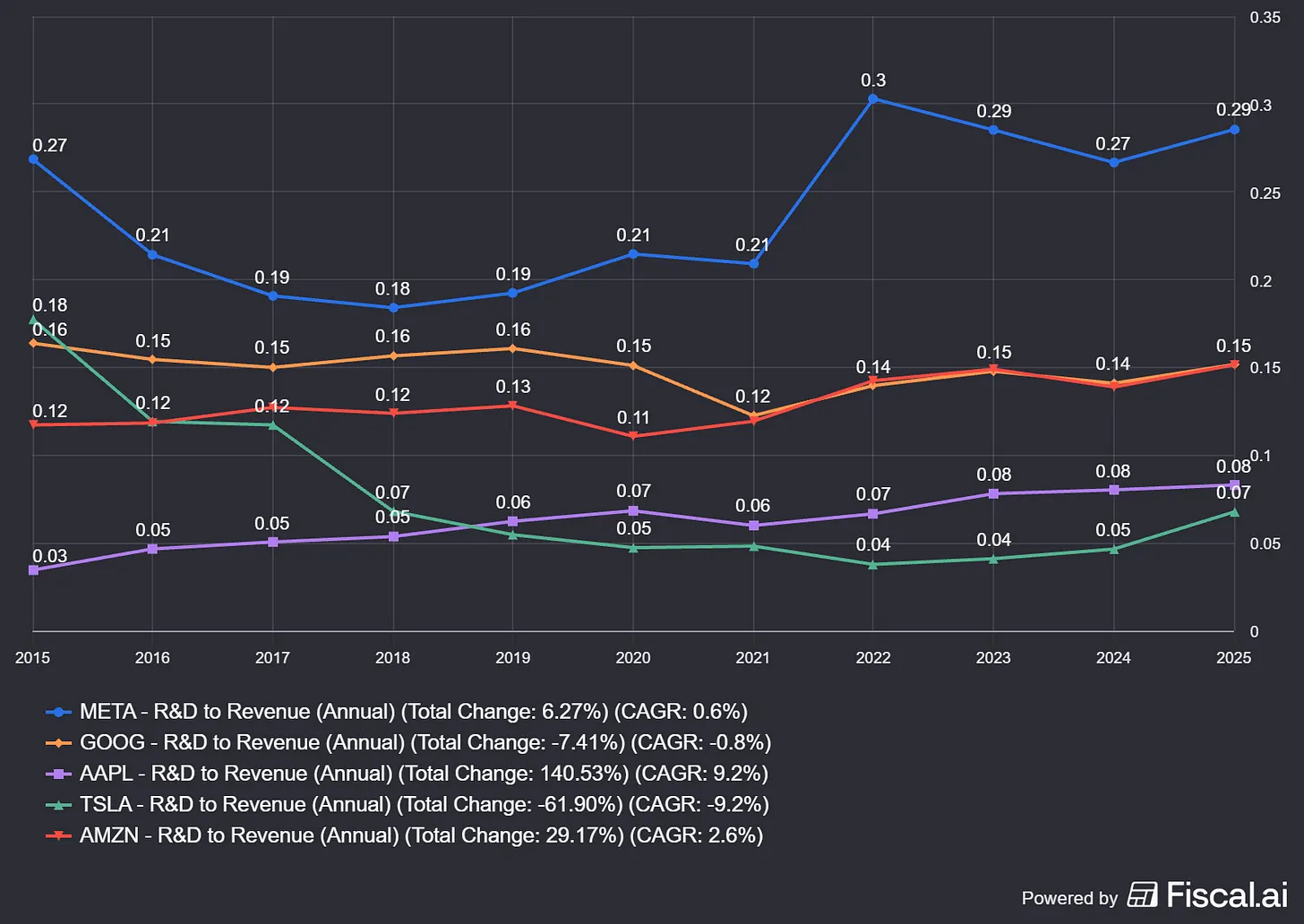
Just take a look at the R&D to revenue ratios of many of the major technology firms:
Source: Fiscal.AI
See how Meta is almost double that of the next highest value (Amazon)?
It doesn't get any clearer than this. Meta offers a compelling example of the founder-led reinvestment thesis.
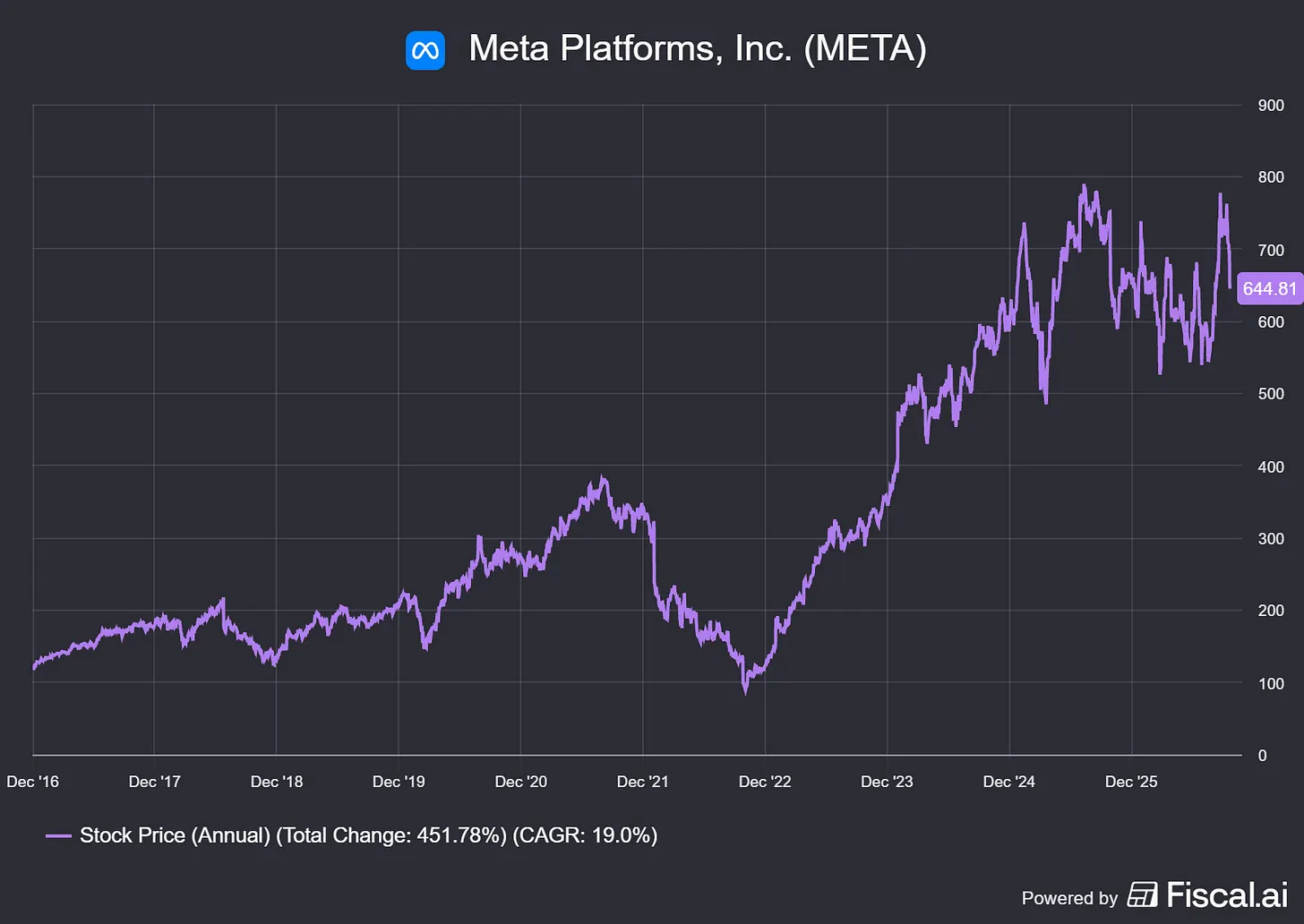
But how has this translated to shareholder value?
A stock price CAGR of 19% over the past decade:
Source: Fiscal.AI
This is compared to the S&P 500, which has performed at a ~13-14% CAGR over the last decade.
Pretty impressive outperformance.
Long live Zuck!
3. Cultural Advantages
Founder-led organizations can develop a distinct advantage in execution.
It is one of the main reasons they are able to outperform competitors.
Think about it.
When a company executes with precision (completing projects faster, delivering superior customer service, winning more deals), it earns higher customer satisfaction and experiences lower internal costs to project completion.
This operational efficiency feeds into stronger profit margins, higher growth, and faster project turnover, allowing the business to reinvest at a higher rate and outpace competitors over time.
This higher level of execution in a founder-led business can often be tied back to an ownership culture.
When people feel responsible for the outcome of their team's work and are personally invested in the business's success, they are bound to execute more effectively.
In other words, they care.
Compare this to a slow-moving incumbent organization where employees are more interested in loitering in the break room to avoid doing work.
Progress stalls, and deadlines are delayed.
It's a small, intangible mindset difference but can drive big gaps in performance over time.
Another cultural alignment consideration is urgency.
Founder-led businesses tend to have a core mission that employees believe in. Belief turns to motivation and quicker execution across teams.
This belief system is reinforced top-down through founder control.
As Bain & Company put it:
“no matter how big and powerful the company is, employees still feel a sense of insurgency. They are out to upset the status quo because they are determined to fill a need in the market that competitors are not addressing." - Founder's Mentality, Bain & Co.
This motivation pushes people to fit in that extra experiment, push to finish those last lines of code, or test out a new product that they would not have normally done otherwise.
That urgency is what drives a faster building process.
A perfect example of this is Nubank ($NU), led by the founder David Vélez since its inception in 2013.
When Vélez launched Nubank, the goal wasn't to simply build another finance platform for Latin Americans.
It was to, in their own words, "fight complexity to empower people" in their daily lives by reinventing financial services.
This was at a time where treatment of low-income consumers was extremely poor, and the incumbent banks only tailored services to the high-net-worth customers.
Severe customer dissatisfaction created a perfect storm for Nubank, and their mission to democratize finance is not just a fad, but a true north star that employees believed in.
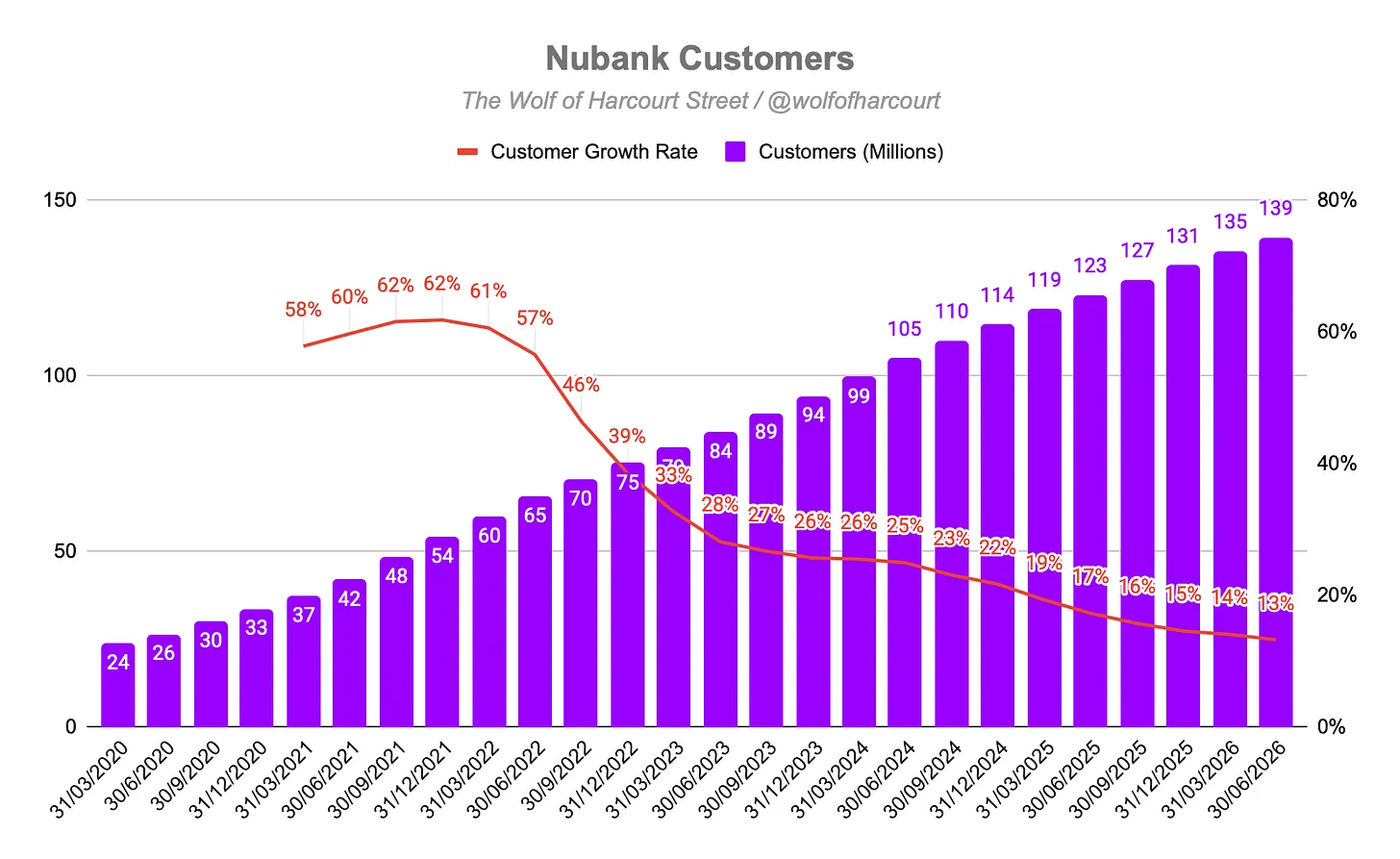
Recently, Nubank disclosed that they service over 60% of the Brazilian population. That's over 115 million customers, just in Brazil. This is all in only 13 years.
Source: Nu Investor Presentation
Nu is known for building, testing, and shipping financial products in weeks.
They've scaled at an unprecedented rate to onboard millions of users while legacy bank executives were still holding committee meetings.
Now that's employee execution in numbers.
The last cultural intangible that contributes to founder outperformance is customer focus and simplicity.
Founder-led organizations tend to foster cultures that obsess over the customer experience.
This becomes true over all layers of the organization, from front-line workers to even the founder CEO.
These businesses attempt to reduce bureaucratic friction to get as close to the customer as possible.
“Complexity is antithetical to maintaining a Founder's Mentality culture. Founders hate bureaucracy, largely because it keeps them from maintaining close links to the front line and customers." - Founder's Mentality, Bain & Co.
What better way to illustrate this than to return to Nubank?
According to their 2021 Preliminary Prospectus, Nubank outlined 4 core values:
-
"Customer-Centric Culture (We Want Our Customers to Love Us Fanatically; We Think and Act Like Owners, Not Renters; We Are Hungry and Challenge the Status Quo; We Pursue Smart Efficiency; We Build Strong and Diverse Teams)
-
Extraordinary Customer Experiences (Mobile and Digital First Products; Product Simplicity; Human-Centered Design; Seamless Integration; Our Xpeers Support Team)
-
Advanced Technology (NuCore Technology Platform; A Microservices Approach; Immutable Architecture; World-Class Software Engineers)
-
Proprietary Data Science (Proprietary Data; Powerful NuX Credit Engine; Artificial Intelligence and Machine Learning; Self-Driving Ecosystem)"
Notice how their first core value is customer centricity?
Not every company operates this way.
In many interviews I've listened to and many testimonials I've read, this customer centricity is real.
There's a famous story that Vélez often talks about, where they accidentally forgot to send customers reminders that payments were due.
In the following week, their algorithms automatically charged late fees to customers. But rather than keep the profit, they took a different approach.
They completely refunded the money back to the customers.
Name one company that has done something like this before.
I can't.
By choosing simplicity and transparency over short-term fee extraction, Nubank earned the customer loyalty they cared so much about.
This helped drive the word-of-mouth referral system that helped Nubank grow to be such a dominant player in the fintech industry in Latin America.
So, what is it that makes founder-led companies so special?
It comes down to three things.
They care more. Their name, reputation, and life's work are tied to the business. They have a personal incentive to build something that lasts.
They think differently about capital. Rather than optimize for the next quarter, they are often willing to reinvest, experiment, and make decisions that may take years to pay off.
They build differently. A strong founder-led culture creates a sense of ownership, urgency, and customer focus that can be difficult to replicate in a large, bureaucratic organization.
Put these together, and you begin to understand why some founder-led businesses can sustain a competitive advantage over time.
But there's an important distinction here.
Being a founder does not automatically make someone a great capital allocator. The same conviction that allows a founder to pursue a long-term vision can also turn into stubbornness. Reinvestment can create tremendous value, but only when the returns justify the capital committed. And strong founder control can preserve a company's culture, but it can also prevent the business from adapting when the original vision no longer makes sense.
The goal isn't to find a founder at all costs. It's to find a business where ownership, incentives, capital allocation, and culture all work toward the same objective: creating long-term value.
Because ultimately, the founder's title matters far less than how they think, what they prioritize, and how they put capital to work.
And for long-term investors, those are the traits worth looking for.
More soon,
Blake at Vassant